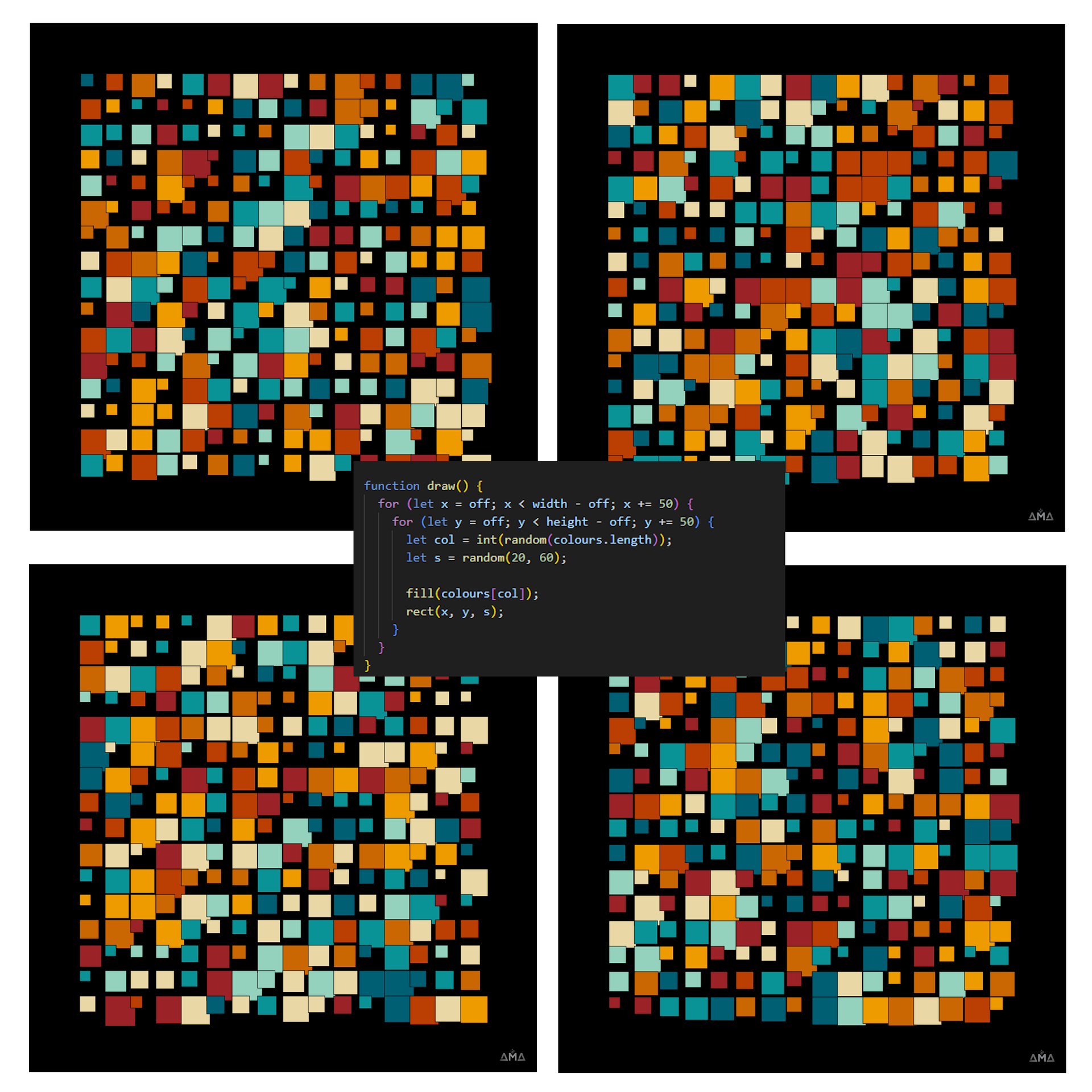
As an IT professional, I’ve often found myself drawn to the allure of control and precision. However, as a generative artist, I’ve come to appreciate the beauty of randomness. It’s a liberating experience that can help control freaks like myself step out of our comfort zones and unlock new artistic possibilities.
I create or start most of my work using P5.js, a versatile JavaScript library for creative coding. You can create unpredictable variations in your artwork by integrating random functions into your code. For instance, consider using random() to generate different colours, shapes, or patterns, giving your art a dynamic and ever-changing quality. Take the example of a simple generative art project where random lines are drawn on a canvas. The lines appear differently each time the code runs, leading to a delightful surprise with every iteration. This spontaneity can be exhilarating for those used to strict control.
Psychologically, this approach offers several benefits. It encourages us to let go of the need for perfection and embrace imperfections as part of the creative journey. It fosters a sense of curiosity and exploration, where we’re not just creating art but also discovering it along the way.
Incorporating randomness into generative art is a reminder that beauty can emerge from chaos, and innovation often arises from unpredictability. So, whether you’re a control freak or someone looking to infuse your art with fresh energy, consider letting randomness guide your creative process. It may lead you to unexpected and breathtaking artistic horizons.
In my case, I keep two constants — a black background and my colour palette. In all other aspects, I welcome surprises, or at least I try. I need to do it more often.